Introduction
Body piercing is increasingly popular across the the UK and beyond, but with it comes real risk. Understanding infection rates, patterns, and factors is key for practitioners, regulators, and clients alike. This article draws on current studies to highlight what the evidence shows – and what gaps still exist.
1. Prevalence of Piercing & Complication Rates
-
-
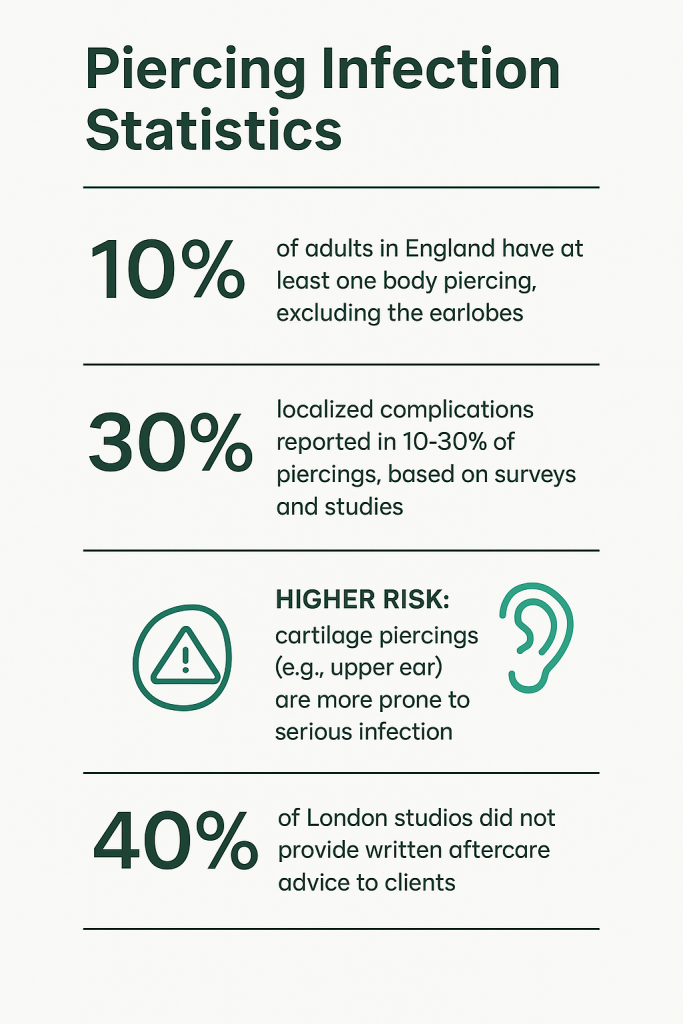
In studies of body piercing (excluding earlobe) in England, 10 % of adults reported having at least one body piercing.
-
In one English survey, among those aged 16–24, 31 % of piercings resulted in complications, with ~15 % of those requiring professional help.
-
In a “look‑back” study of clients, 36 % (211/581) self‑reported a skin infection after piercing.
-
In literature reviews and wound‑care research, localised infections are reported in 10–30 % of body piercings – though this range is broad and depends heavily on reporting definitions.
-
Studies also show that cartilage (ear upper regions) piercings tend to have more issues like perichondritis and abscesses, sometimes severely deforming if not treated.
-
2. Outbreaks & Special Cases
-
A notable outbreak in the UK – the “Black Friday” event – saw 11 infections (attack rate ~24 % among exposed patrons) after scaffold ear piercings using guide bars. Some cases needed surgical drainage.
-
Pseudomonas aeruginosa is a known culprit for serious ear cartilage infections (perichondritis) associated with upper ear piercings. The UK government has published guidance specifically warning about this risk.
3. Risk Factors & Patterns
-
Cartilage piercings have less blood flow and defense, making them more vulnerable to complications.
-
Using guide rods or bars in piercing (as seen in the outbreak) increases risk of tissue trauma and infection.
-
Poor aftercare, delays in seeking treatment, or lack of professional oversight amplify complications.
-
In some surveys, many studios did not provide written aftercare advice or consistently warn about cartilage risks. In London, one study found 40 % did not provide written post‑piercing guidance.
4. What the Numbers Don’t Show - Limitations & Gaps
-
Definitions of “infection” vary (mild redness vs. requiring medical intervention).
-
Self-reporting bias: many infections mild or managed privately may never be recorded in clinical data.
-
Lack of UK-specific, large-scale, long-term studies focusing exclusively on body piercing (distinct from tattoos).
-
Under‑reporting of severe sequelae or long-term complications (scarring, cartilage loss).
5. Implications for the Industry (Pierce Safe’s Role)
-
Use conservative safety margins: even if “only 10 %” get some infection signs, practitioners must aim for <1 %.
-
Strengthen data collection: insisting studios report complications, anonymised data sharing, audits.
-
Monitor outbreaks and respond with guidance quickly (as in the Pseudomonas cartilage risk).
-
Educate clients: help them understand that even with “clean” studios, risk isn’t zero.
Conclusion & Key Takeaways
-
Infection rates after piercing are nontrivial – 10–30 % for localised complications in many reports.
-
Cartilage piercings, especially upper ear, carry disproportionately higher risk.
-
Outbreaks like the “Black Friday” example show the danger of procedural shortcuts.
-
With better standards, training, certification, and oversight (which Pierce Safe aims to deliver), the goal should be to reduce these rates significantly.